Cybersecurity · 5 min read
Why layered cybersecurity matters for small and mid-sized businesses
Cybersecurity is no longer just an enterprise concern. Small and mid-sized businesses are often just as exposed as larger organizations, but without the same internal security staff, tools, or response planning.
A single security tool is not enough to protect a business today. Attackers may come through email, stolen passwords, unmanaged devices, cloud accounts, weak backups, vendor access, or employee mistakes. Layered cybersecurity helps reduce risk by protecting multiple parts of the business at the same time.
What layered cybersecurity means
Layered cybersecurity means using multiple protections that work together. Instead of relying on one product or one control, each layer helps cover a different area of risk.
For example, email security can help reduce phishing. Multi-factor authentication can help protect accounts if a password is stolen. Endpoint protection can help defend laptops and desktops. Backup planning can help a business recover if something goes wrong.
No single layer is perfect, but together they create a stronger defense.
Why small and mid-sized businesses need layers
Many businesses assume they are too small to be targeted. In reality, attackers often look for easier opportunities. A business with weak passwords, unprotected devices, inconsistent backups, or limited monitoring can become a target because it is easier to compromise.
Small and mid-sized businesses also tend to rely heavily on a few key systems. If email, Microsoft 365, accounting software, phones, or shared files go down, daily operations can slow quickly. Cybersecurity is not only about preventing attacks. It is also about reducing downtime, protecting productivity, and keeping the business moving.
The most important security layers
A strong cybersecurity foundation usually includes several key areas.
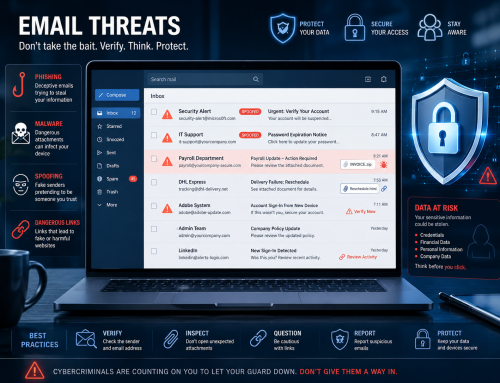
Email security helps reduce phishing, spoofing, suspicious links, and malicious attachments before they reach users.
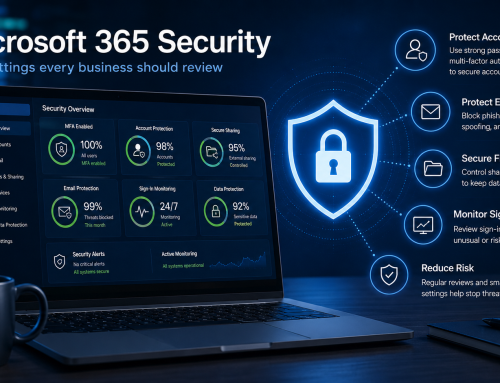
Multi-factor authentication adds another layer of protection to important accounts, especially Microsoft 365, cloud apps, remote access tools, and administrative accounts.
Endpoint protection helps secure laptops, desktops, and other devices from malware, ransomware, and suspicious activity.
Security monitoring improves visibility into alerts, unusual behavior, device health, and potential threats.
Backup and recovery readiness helps make sure business data can be restored if files are deleted, encrypted, or lost.
Cloud security helps control access, permissions, file sharing, and account settings across cloud platforms.
User awareness helps employees recognize suspicious emails, unsafe links, and risky requests.
Network security helps protect connectivity, Wi-Fi, firewalls, and the systems that keep users connected.
Each layer supports the others. For example, backups are important, but they are more effective when combined with endpoint protection, access controls, monitoring, and a clear recovery plan.
Why passwords are still a major risk
Weak or reused passwords remain one of the most common security problems. If an employee uses the same password across multiple services, one exposed password can put business systems at risk.
Multi-factor authentication helps reduce this risk by requiring a second form of verification. Even if a password is compromised, MFA can make it much harder for an attacker to access the account.
This is especially important for Microsoft 365, email, administrator accounts, remote access, and financial systems.
Backups are not enough by themselves
Many businesses believe they are protected because they have backups. Backups are important, but backup readiness is more than simply having a backup system in place.
A business should know what is being backed up, how often backups run, how quickly data can be restored, and who is responsible during a recovery. If backups are not monitored or tested, they may not work when the business needs them most.
Recovery planning is a key part of cybersecurity because the goal is not just to prevent problems. The goal is to recover quickly if an incident happens.
The role of MDR and monitoring
Managed Detection and Response, often called MDR, can help businesses gain better visibility into suspicious activity. MDR can support alert review, endpoint visibility, escalation guidance, and response coordination.
For small and mid-sized businesses, MDR can be valuable because it helps fill the gap between basic protection and a more mature security program. It does not replace good security basics, but it can strengthen the overall cybersecurity approach.
MDR works best when it is part of a broader layered model that includes email security, endpoint protection, MFA, backups, cloud controls, and user awareness.
Cybersecurity should be practical
A layered cybersecurity approach does not have to be overwhelming. The goal is not to add complexity for the sake of complexity. The goal is to identify the most important risks, close the biggest gaps, and create a practical security foundation that fits the business.
For many small and mid-sized businesses, the best starting point is a review of users, devices, email, Microsoft 365, backups, remote access, and current security tools. From there, the business can prioritize improvements that reduce the most risk.
Final thought
Cybersecurity is strongest when it is layered, practical, and maintained over time. Email protection, MFA, endpoint security, monitoring, backups, cloud security, user awareness, and recovery planning all work together to reduce business risk.
Small and mid-sized businesses do not need to build an enterprise security department to improve protection. They need the right layers, the right guidance, and a clear plan for reducing risk before threats become downtime.
Ready to strengthen your security layers?
MVR Group helps small and mid-sized businesses improve cybersecurity with practical protection across email, users, devices, cloud systems, backups, and monitoring.
Schedule a Free Cybersecurity Review